Software · Cloud · Automation · Integration
Digital architecture for working businesses.
TONY Verwaltungs GmbH is an IT company that plans, builds and maintains software systems — from custom applications to the infrastructure and integrations that keep them running.

01Company overview
Engineering that stays legible after launch.
We work with organisations that need software tailored to how they actually operate. Our focus is the full lifecycle: understanding the problem, designing a sensible structure, writing the code, deploying it and keeping it healthy.
We favour clear architecture, documented decisions and incremental delivery, so the systems we build can be understood, extended and maintained by the people who rely on them.
02Core technology capabilities
Four disciplines, one connected practice.
Product engineering
Backend services, web front-ends and internal tools built as maintainable, documented codebases.
Cloud operations
Infrastructure defined as code, deployment pipelines, environment management and observability.
Automation
Replacing manual, repetitive steps in business processes with dependable software routines.
Integration
Connecting existing applications through APIs, data synchronisation and event-driven messaging.
03Software development expertise
Built around your domain, not a template.
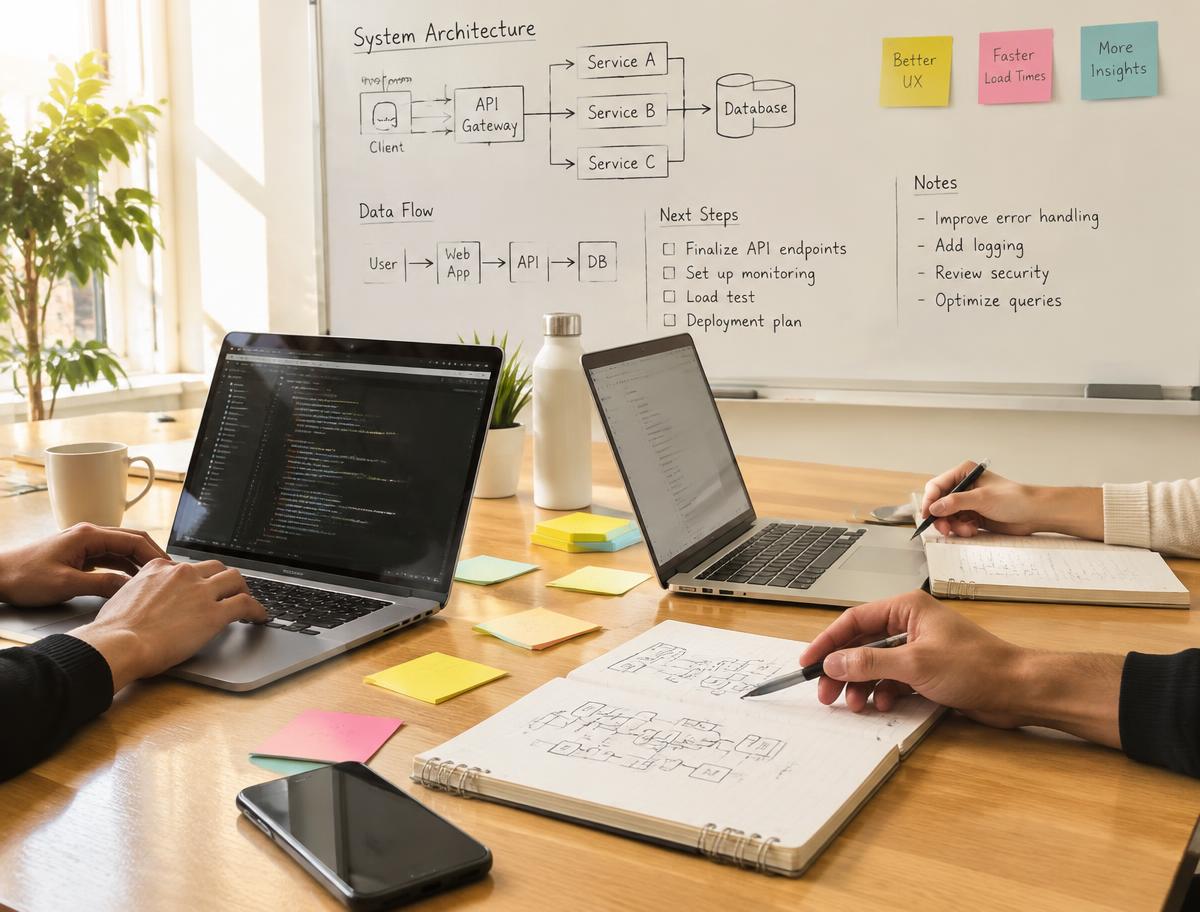
- Domain modelling — translating business rules into data structures and services that reflect them accurately.
- Web applications — responsive interfaces, role-based access and accessible components.
- Backend services — APIs, background jobs, data storage and reporting.
- Code quality — reviews, automated tests and conventions agreed with your team.

04Cloud and infrastructure
Infrastructure you can read like code.
We set up and support hosting environments using reproducible configuration, so environments can be recreated, reviewed and audited.
- Provisioning
- Infrastructure-as-code for networks, compute and storage.
- Pipelines
- Automated build, test and deployment workflows.
- Observability
- Logging, metrics and alerting for running services.
- Cost awareness
- Right-sizing resources to actual usage patterns.
05Business process automation
Fewer copy-paste steps. More dependable routines.
Many organisations rely on spreadsheets, email chains and manual re-entry of data between systems. We map these workflows, identify the steps that are repetitive and rule-based, and automate them with traceable software.
Typical examples include document generation, approval flows, scheduled data imports, notifications and reconciliation between systems.
06Systems integration
Making separate systems speak one language.
We design and implement integrations between business applications, third-party services and internal databases — REST and GraphQL APIs, webhooks, message queues and scheduled synchronisation — with error handling and monitoring built in.
07Delivery process
A path from question to running system.
- 1
Discovery
We study the current situation, constraints and the outcome you need, and write it down in plain language.
- 2
Architecture
We propose a technical approach, outline trade-offs and agree on scope before significant code is written.
- 3
Iterative build
Work is delivered in short increments that can be reviewed, tested and adjusted along the way.
- 4
Verification
Automated tests, code review and staged releases check that each increment behaves as intended.
- 5
Handover & care
Documentation, deployment notes and optional ongoing maintenance keep the system understandable.
08Engineering quality and reliability
Quality as a habit.
Automated testing
Unit, integration and end-to-end tests chosen according to risk.
Peer review
Every change is read by a second engineer before it is merged.
Staged releases
Changes move through test environments before production.
Documentation
Architecture notes and runbooks kept alongside the code.
09Security-conscious development
Security considered from the first line, not the last.
- Least-privilege access for users, services and infrastructure.
- Secrets kept out of source code and managed separately.
- Input validation and safe handling of personal data.
- Regular dependency updates and vulnerability checks.
- Logging that supports investigation without exposing sensitive data.
10Collaboration and communication
Clear words, shared context.
We explain technical decisions in terms of their impact on cost, time and risk. Progress is shared regularly through written updates and demonstrations of working software.
Open questions, assumptions and changes in scope are documented, so that everyone involved works from the same understanding.
11Frequently asked questions
Answers, in the open.
What kinds of projects do you take on?
Custom software, web applications, cloud and infrastructure work, workflow automation, API integrations, technical consulting and maintenance of existing applications.
Can you work with an existing codebase?
Yes. We usually begin with a review of the code, its dependencies and deployment setup, then propose a prioritised list of improvements.
How is scope defined?
Scope is agreed in writing after an initial discovery phase. It describes features, assumptions, exclusions and how changes are handled.
Which technologies do you use?
We choose established, well-supported technologies that fit the problem and your team's ability to maintain them, rather than a fixed stack.
Who owns the resulting code?
Ownership and licensing terms are set out in the individual project agreement before work begins.
How do we get in touch?
Write to [email protected] with a short description of your project or question.